What It's Like to Work With Me
or, in simpler terms: how I approach puzzles, problems, and life in general
The Context
For years, I've tried to explain how I approach problems: why I ask certain questions, how I build systems, and what I notice that others might miss. This diagram maps that working style using patterns gathered across my personal systems and professional practice.
At the center is the Care Core, the organizing principle that drives everything. Every system I build, every question I ask, every tool I create exists to improve outcomes for the people inside it.
NotebookLM generated the diagram from a detailed context file and prompt. The working model is mine; the illustration is the tool's output.
The Working Model
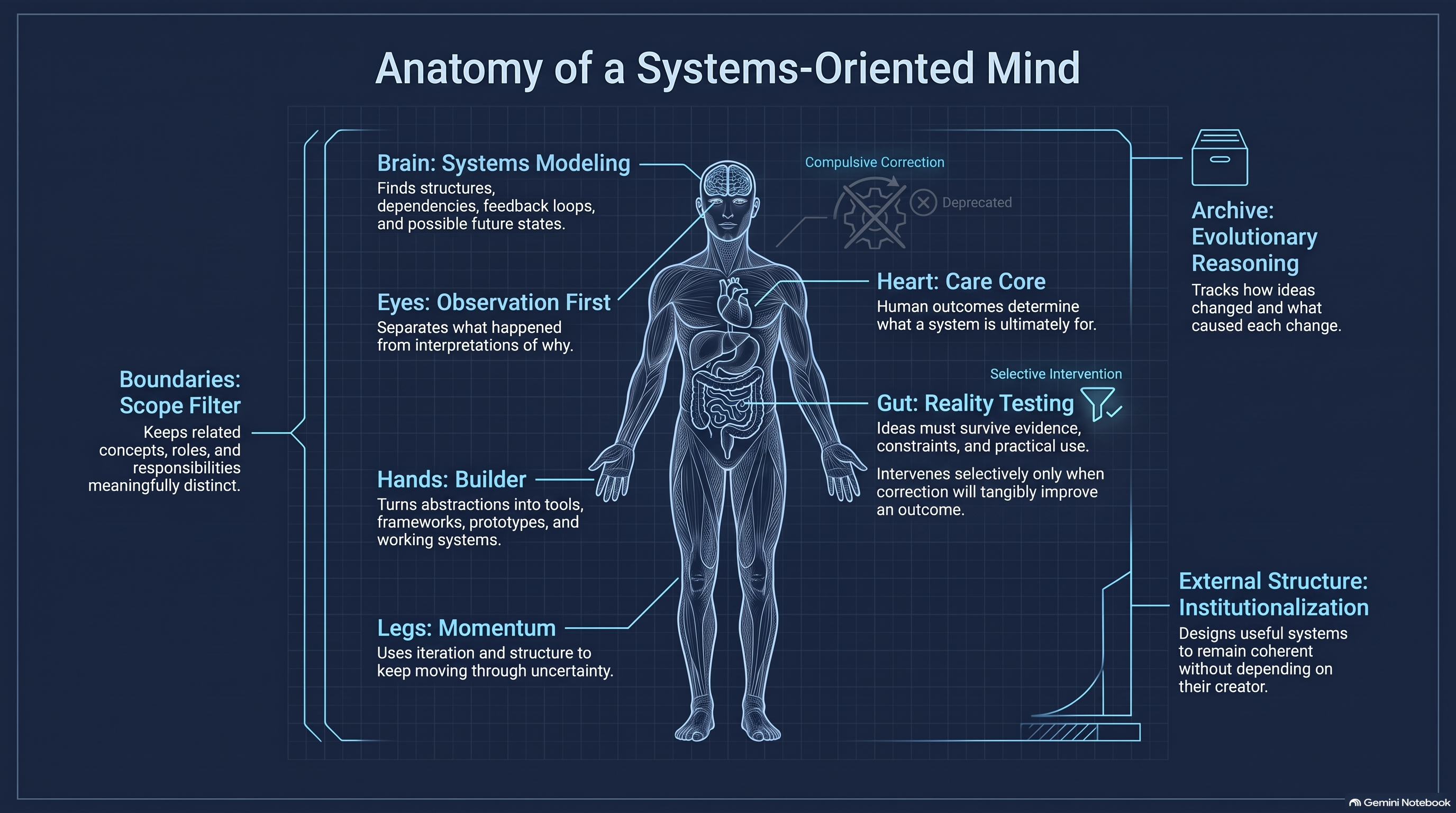
What I'm Like as a Coworker
When things get complicated
I often become the person people bring complicated problems to. I stay calm when priorities change and work independently while keeping the broader goal in view.
When things need structure
I ask questions early, document decisions, and clarify ownership and information. I help technical and non-technical teams understand each other and agree on what happens next.
When I'm leading
I'm direct and supportive. I set clear expectations, share context, and listen carefully. I'd rather help people work through problems than simply hand them instructions.
What I care about
I care about the quality of the outcome and the experience of the people producing it. A good system protects both.
How do I know when a project is done?
I have a tendency to keep seeing ways to improve things, even after they're working. It can be a better interaction, a clearer explanation, or an edge case that deserves attention. That instinct is useful during development, but it can't be the definition of when a project is finished, because there will almost always be something else worth exploring.
For me, completion is something we establish together. We agree on what the project needs to accomplish, what the deliverables should include, and how we'll know they've met those expectations. When the work meets those criteria, we've verified that it functions as intended, and the people receiving it can actually understand and use it, the project can be considered complete.
That last part matters to me. A technically correct deliverable isn't particularly helpful if the people responsible for using it can't figure out what to do with it. Depending on the project, a proper handoff might involve documentation, walkthroughs, testing, or making sure the next person understands the decisions behind what they're receiving.
What happens when I spot something that could be better?
It depends on what I've found.
If something doesn't behave as agreed, or if an interaction creates confusion that interferes with its intended use, I consider that worth addressing. The original requirements are our baseline, but there's room for judgment when a problem affects usability, clarity, or the outcome we were trying to achieve.
If I've simply thought of a different design, a nicer visual treatment, or a deeper UX improvement that goes beyond what the client needs or intends to pursue, I don't automatically turn that into more work. I can recognize that something could be different without insisting that it should be.
And if an improvement is genuinely valuable but falls outside the agreed scope, we can discuss whether it's worth pursuing separately. Discovering another possibility doesn't mean the original project was incomplete.
The goal is to leave you with something that works, makes sense, and fulfills what we agreed to do. My curiosity might continue after that, but your project doesn't have to remain open just because I can imagine another version of it.